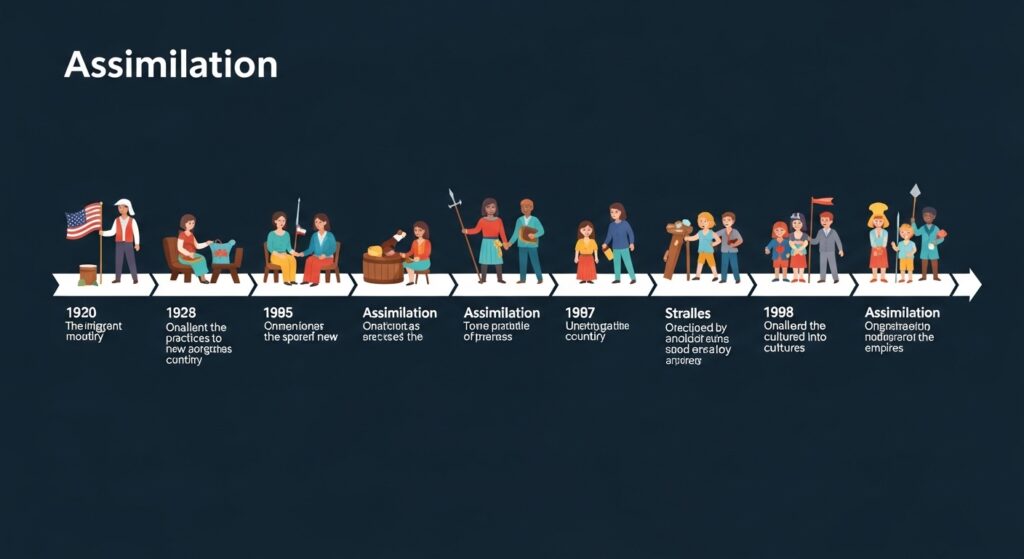
In linguistics, social sciences, and cultural studies, the term assimilasjon plays an important role in understanding how systems, communities, and individuals adapt and integrate. While the concept is used in different contexts, it generally refers to the process by which elements merge, influence each other, or conform to existing patterns.
What Is Assimilasjon?
Assimilasjon is the Norwegian term for “assimilation,” and it broadly refers to the process in which one element becomes similar to another. The term is most commonly used in the following contexts:
- Linguistic Assimilation: The phenomenon in language where sounds change to become more like neighboring sounds.
- Cultural Assimilation: The process by which individuals or groups adopt the cultural traits or norms of another society.
- Social or Biological Assimilation: Adaptation processes in society or biology where elements adjust to fit into a larger system.
By understanding assimilasjon, researchers and educators can better interpret how languages evolve, how societies integrate, and how systems adapt over time.
Linguistic Assimilasjon
In language, assimilasjon occurs when a sound changes to become more like a neighboring sound in pronunciation. It is a natural part of speech and occurs in most languages.
Examples of Linguistic Assimilation
- Regressive Assimilation: A sound is influenced by the sound that comes after it. For example, in Norwegian, the phrase “god dag” might be pronounced more like “goddag” in casual speech, where the first consonant adapts to the following one.
- Progressive Assimilation: A sound influences the one that follows it. For instance, in English, “dogs” is pronounced with a /z/ sound at the end because of the preceding voiced /g/ sound.
- Coalescent Assimilation: Two sounds merge into a single new sound. For example, English “did you” can sound like “didju.”
Linguistic assimilation demonstrates how languages naturally evolve for efficiency and ease of pronunciation.
Cultural and Social Assimilasjon
Beyond language, assimilasjon is an important concept in cultural and social contexts. It describes how individuals or groups integrate into broader societies while adopting cultural norms, practices, or languages.
Key Features of Cultural Assimilation
- Adoption of Language: Immigrants often adopt the dominant language to communicate effectively.
- Integration of Traditions: People may incorporate local customs, social norms, and practices.
- Social Conformity: Adapting behaviors or values to align with societal expectations.
Cultural assimilation is a complex and sometimes sensitive process. It can foster social cohesion but may also raise concerns about the loss of individual or minority identities.
Biological and Scientific Assimilasjon
In biology and other scientific fields, assimilasjon refers to the process by which organisms integrate nutrients or energy from their environment to grow and function.
Examples of Biological Assimilation
- Plants assimilate carbon dioxide through photosynthesis to create energy.
- Animals assimilate nutrients from food to build tissues and sustain life.
This usage emphasizes adaptation and integration in natural systems, highlighting the versatility of the concept across disciplines.
Importance of Understanding Assimilasjon
Studying assimilasjon helps in multiple ways:
- Language Development: Helps linguists understand sound changes and language evolution.
- Social Integration: Assists policymakers and educators in supporting multicultural societies.
- Scientific Insight: Provides understanding of how organisms and systems adapt and thrive.
- Cultural Awareness: Encourages recognition of the balance between integration and preservation of identity.
By analyzing assimilasjon, we can better understand patterns of adaptation, integration, and change across different fields.
Challenges and Considerations
While assimilasjon can be beneficial, it also presents challenges:
- Loss of Original Identity: In cultural assimilation, individuals may lose aspects of their heritage.
- Resistance to Change: Some elements or groups may resist assimilation, leading to social tension.
- Miscommunication in Language: Over-assimilation in speech may cause misunderstanding or ambiguity.
These challenges highlight the importance of considering context and balance when studying or applying assimilasjon.
Conclusion
Assimilasjon is a multifaceted concept that spans linguistics, culture, society, and biology. Whether in the adaptation of sounds in speech, the integration of cultural practices, or the absorption of nutrients in organisms, assimilasjon reflects the natural process of change, adaptation, and integration.
Understanding assimilasjon allows us to appreciate the ways in which systems—linguistic, social, or biological—evolve and adapt, providing insight into human behavior, societal development, and natural processes.